




“This is not Pakistan, where you can use armed forces to remove someone from power,” said the Trinamool Congress politician Tapash Chatterjee, his voice rising in disbelief. “In our country, leaders have always been changed democratically.”
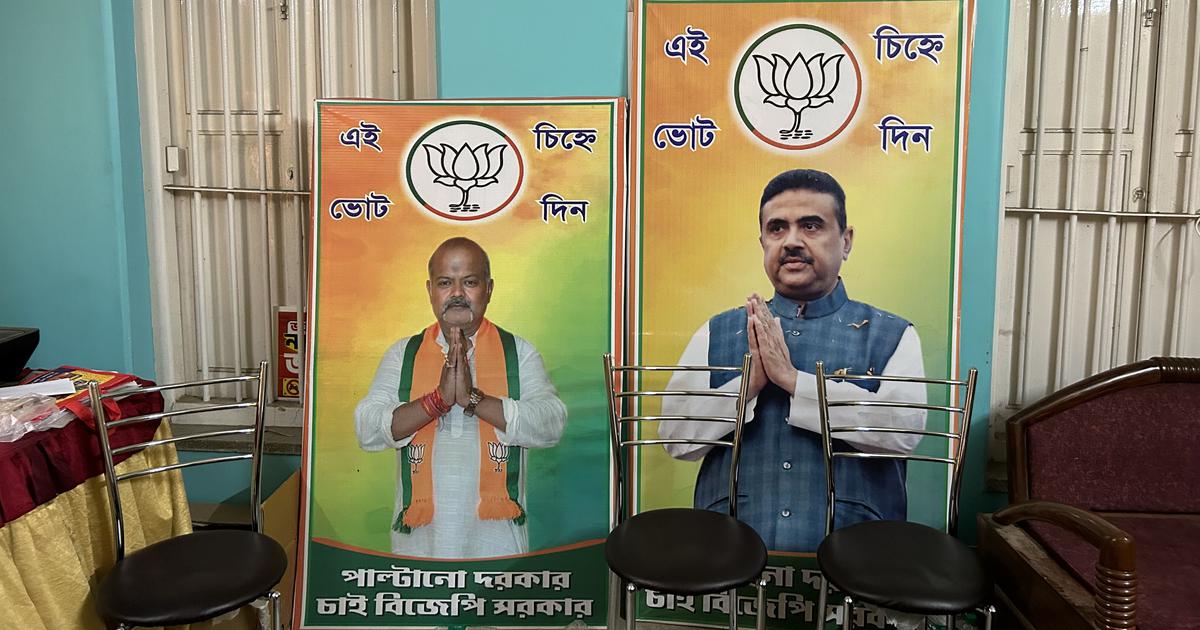
Chatterjee, who joined the Trinamool in 2015, was till last week the MLA from Rajarhat New Town, a suburban seat near Kolkata airport. His was one of the 207 seats that the Bharatiya Janata Party won as it stormed to power for the first time in West Bengal.
However, Chatterjee insists that the election was stolen from him. He points out that he finished with more votes than anybody else when counting concluded late on the night of May 4. The data put out by the Election Commission of India bears this out.
Although Chatterjee had secured the highest number of votes at the end of the day, election officials did not give him a certificate declaring his win. The next day, these officials added some more votes to the candidates’ tally and awarded the seat to the BJP.
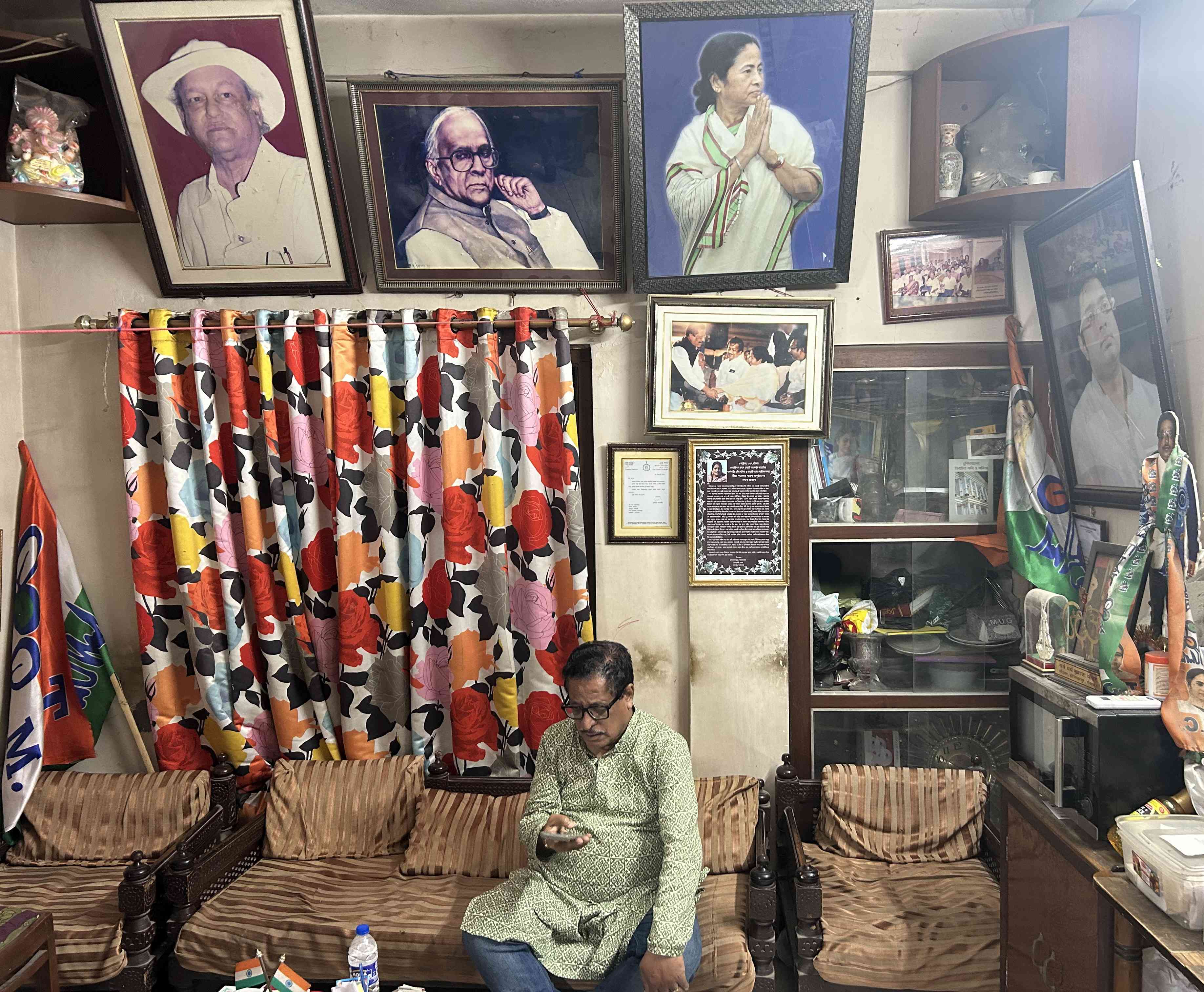
His constituency is now at the centre of the controversy over what happened in Bengal on the day of the results.
The Trinamool claims that the BJP colluded with the Election Commission to slow down the counting of votes in its strongholds and sped it up in seats that the BJP was winning. As a result, a BJP win seemed imminent by mid-afternoon even though only a fraction of the votes had been counted.
In Rajarhat New Town, BJP workers then violently drove away despondent Trinamool counting agents, even as central forces watched, allowing counting fraud to take place, Tapash Chatterjee alleged. Besides him, Scroll spoke to other candidates and party workers to piece together an account of what transpired in the constituency’s counting centre on May 4.
The process
The Election Commission had set up a total of 330 polling stations in this constituency on the day of the vote. After voting concluded, the 330 electronic voting machines from these stations were taken to Bidhannagar College, the designated counting venue.
On May 4, the day of counting, it was expected that postal ballots would be accounted for first, as is usually the case. Election officials had informed all the candidates that machine votes would be counted across 17 rounds after this.
In each of the first 16 rounds of counting, the number of votes polled by each candidate in 20 different machines would be recorded. And in the final round, the votes from the remaining 10 machines would be counted.
For this purpose, 20 tables had been set up in the college. Every round of counting would involve opening one voting machine on a table and recording its result on a chart. Candidates were also asked to appoint a counting agent for each table to observe the process.
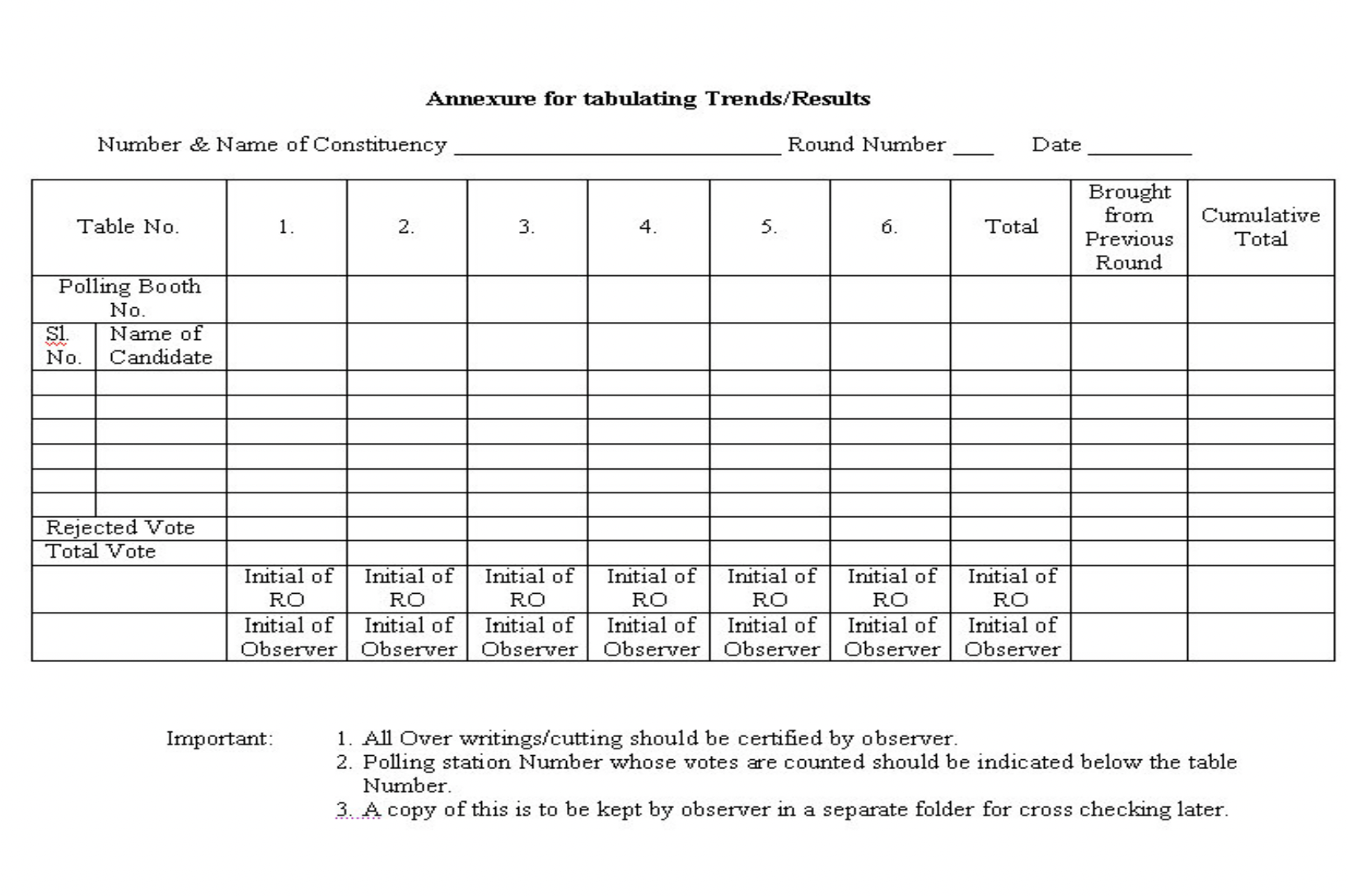
Typically, candidates tabulate their own result by putting together the numbers that they receive from their counting agents. This goes on in parallel with the counting carried out by election officials.
After each round of counting, candidates can match their own results with the trends displayed by the Election Commission at the counting centre. In case of a discrepancy, candidates can seek a clarification from the officials and even ask for a recount.
Once all the votes from postal ballots as well as machines have been counted and no disputes remain, the Election Commission’s returning officer records the final tally. The candidate with the highest number of votes is declared the winner and handed a certificate.
Why so slow?
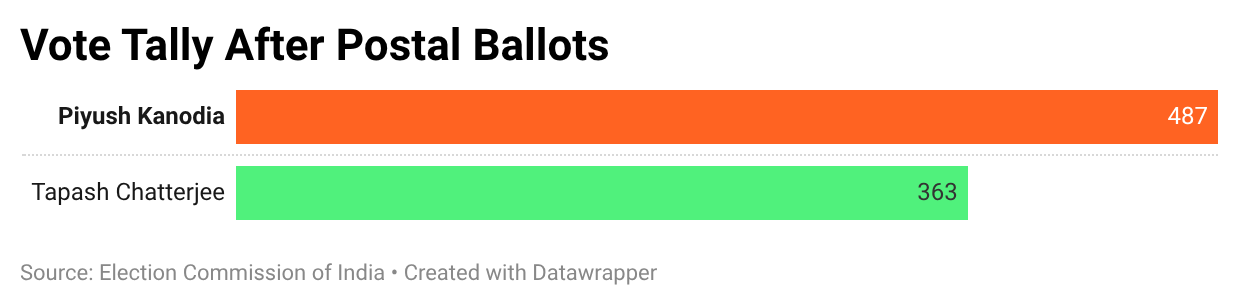
In Rajarhat New Town, a total of 1,032 votes had been cast by postal ballot. When they were counted on the morning of May 4, it emerged that Piyush Kanodia, the BJP candidate, had secured 487 of them, while Tapash Chatterjee of the Trinamool received 363. This would be the first and last time that Kanodia would lead Chatterjee that day.
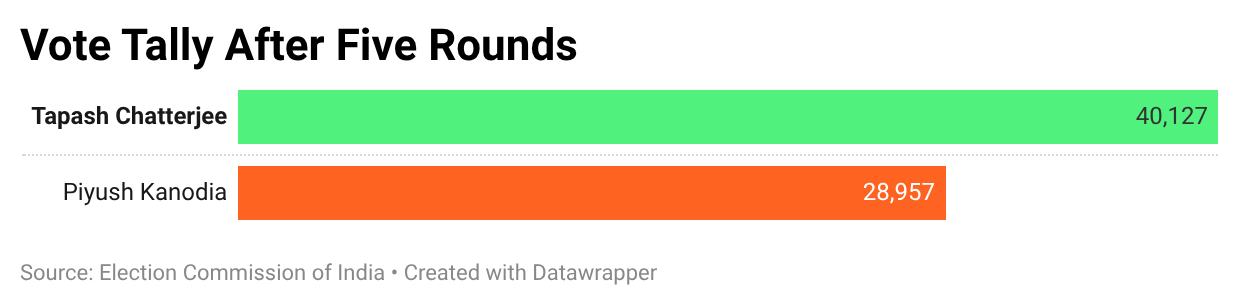
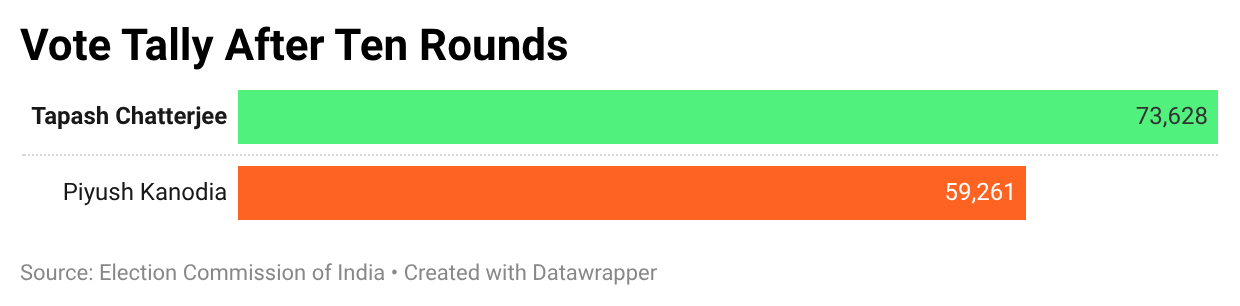
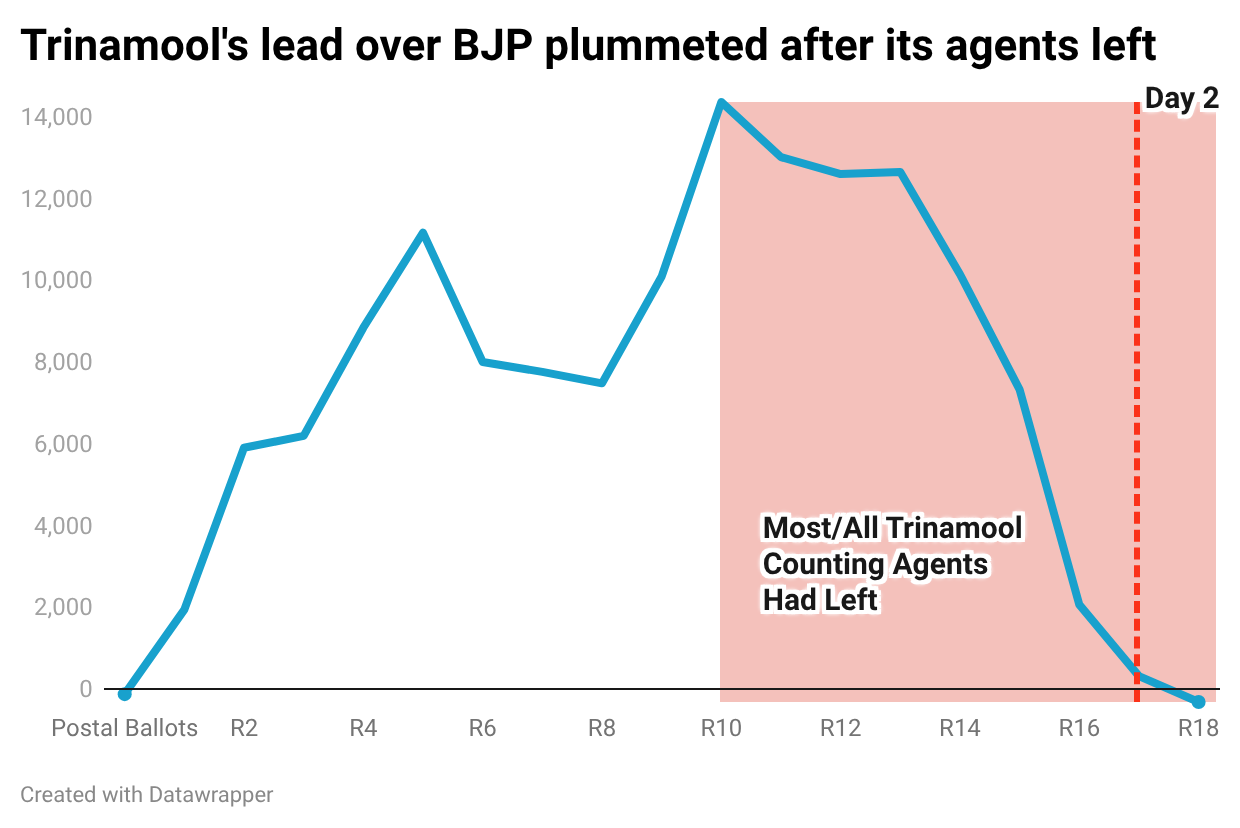
As soon as the counting of machine votes began, the Trinamool leader raced ahead. At the end of five rounds, Chatterjee led Kanodia by more than 11,000 votes. But the process, the Trinamool politician complained, was moving very slowly.
“They [the BJP] devised this strategy,” Chatterjee alleged. “Where we were winning, they slowed down the counting. And where they were winning, it was quick.”
Chatterjee’s allegations are borne out by events in Bidhannagar College itself, which functioned as the counting centre for three seats. The BJP won two of these by sizeable margins and the results for them were announced on the evening of May 4 itself. But the counting for Rajarhat New Town went on till the next day.
Election researchers, too, had pointed out that counting in Bengal was progressing at a slower pace than other states whose votes were being tallied on the same day. By noon, the trends showed that the BJP was winning big even though only about a sixth of all the votes cast had been counted.
The then chief minister herself made these allegations, connecting slow counting to election fraud.
“I am requesting all our candidates and counting agents to not leave their centres,” Mamata Banerjee pleaded with her workers in a short video address soon after noon on May 4. “This is the BJP’s plan. There is no need to feel disappointed. Only three or four rounds have been counted so far. Don’t get scared.”
Banerjee’s fears came true in Bidhannagar College.
“Once it became clear that they [the BJP] were winning nearly 200 seats [in Bengal], they started beating up my counting agents,” Chatterjee, the Trinamool candidate from Rajarhat New Town, alleged. “They took away their badges and tore them up [to prevent further entry].”
Though Bengal saw unprecedented deployment of Central paramilitary forces in this election, Chatterjee claims they did not stop the violence in Bidhannagar College. “The central forces did not intervene,” he alleged. “They were totally biased.”
An exodus
Around 4 pm, his counting agents began to trickle out of the counting centre one by one, his daughter Aratrika Bhattacharjee told Scroll. Bhattacharjee, a municipal councillor from the party, was standing outside the whole day.
“Every one of our counting agents came out crying,” she remembered. “Their badges had been snatched away from them. There was no way they could go back in.”
Kanodia, the BJP candidate, denied these accusations. “This is a complete lie,” the 43-year-old said. “He [Chatterjee] should accept that he has lost the election.”
He, in turn, attributed the slow speed of counting to a purported discrepancy in his opponent’s vote tally that stalled the process after the tenth round. By this time, Chatterjee had a 14,000-vote lead over him, according to data put out by the Election Commission.
However, Samruddha Das, one of Kanodia’s counting agents, was more candid when he spoke to Scroll. “Wherever the fight was tough for us, counting took place slowly,” he explained.
The Communist Party of India (Marxist) candidate Saptarshi Deb, who finished a distant third from this seat, also suggested that the slow counting had hit the Trinamool adversely. “When news came in that the BJP was leading everywhere, the Trinamool’s counting agents got demoralised,” he recalled. “After some commotion, a big chunk of them left.”
By early evening, Chatterjee just had a handful of party workers from the area to keep him company, Deb added. That made their task harder, he reasoned, because counting was still taking place on 20 different tables spread across two separate rooms.
Scroll emailed questions regarding the alleged violence on counting day to the police commissioner of Bidhannagar, Tripurari Atharv, and Ashish Choudhary, the Election Commission-appointed police observer for this constituency. This piece will be updated if they respond.
A shrinking lead
Both Chatterjee and Kanodia alleged that election officials had deliberately misrecorded results shown by the machines to favour the other side.
The Trinamool candidate alleged that his substantial lead was systematically wiped out in later rounds of counting after many of his agents had left the premises. He claimed that he would win the seat by 20,000 votes if all the votes were counted again.
On the other hand, the BJP candidate accused his opponent of using his influence over the local bureaucracy to manipulate the results in the initial rounds. He said that he would have won by 15,000 votes if the process was fair from the beginning.
Who would count votes was a highly contentious issue in this election. The Trinamool even moved the Supreme Court against the Election Commission’s decision to deploy Union government employees as counting supervisors. In Rajarhat New Town, the returning officer belonged to the West Bengal Civil Service, while the general observer was an Indian Administrative Service officer from the Odisha cadre.
Deb, the CPI(M) candidate from this seat, admitted that he did not have a shot at winning the election. His party had long opposed both the BJP and the Trinamool, he added.
But when asked if election officials had manipulated the results that evening, Deb backed up the Trinamool’s claims. “Some manipulation did take place,” he said. “The BJP was not in a position to win this seat. Over 30% of the voters here are minorities.”
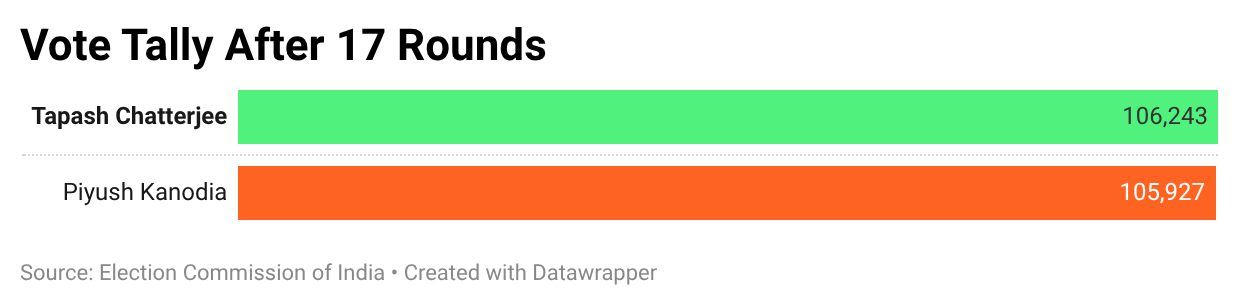
When Deb and his counting agents left Bidhannagar College around 11 pm on May 4, all 17 rounds of counting had been concluded. Chatterjee of the Trinamool was still leading by a narrow margin of 316 votes.
Even at that hour, Chatterjee’s daughter stood outside, waiting for her father to come out of the counting centre as the declared winner from this seat. About 60 workers from the Trinamool were with her.
But the situation would change very quickly just then.
“Around midnight, more than 500 BJP workers arrived there in one go,” she claimed. “They started shouting at us and smashed the windows of my car. We were left with no choice. We had to flee.”
Chatterjee, too, returned from the college empty-handed about two hours later. The former MLA alleged that when he asked election officials to give him the winning certificate, a BJP worker threatened to murder Shahanowaj Ali Mondal, one of his last remaining counting agents.
“Will you take the certificate with you today or his dead body?” the worker whispered into his ear, Chatterjee claimed.
The BJP candidate rubbished Chatterjee’s accusations. “Before he says such things, he must explain why so many people from his area were not able to vote in the past,” Kanodia retorted, suggesting that the Trinamool had practised voter suppression in previous elections.
‘Hello? Hello?’
The next morning, Chatterjee was informed that the last few rounds of counting would be conducted again. He wrote an email to election officials registering his protest against this move. “How can further counting take place without giving us protection?” he asked.
He said that worries about his safety led to him not showing up for the recount.
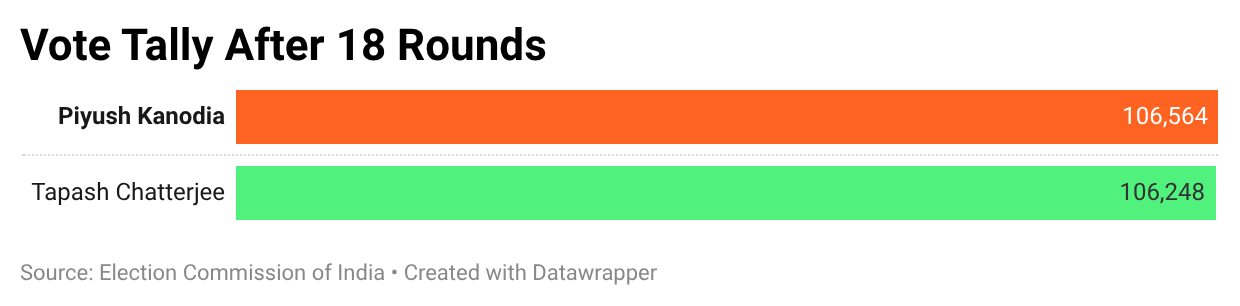
On its website later that day, the Election Commission added an 18th round of counting to the results for Rajarhat New Town. In this round, the BJP candidate got 637 votes while Chatterjee received just five. Before this, the lowest number of votes that the Trinamool leader secured in any round was 1,926.
The votes from this new round were enough to flip the final result. The BJP had won the seat by a wafer-thin margin of 316 votes. In a remarkable coincidence, this was the exact number by which Chatterjee had led Kanodia at the end of the previous day.
This reporter called Mohammed Alimuddin, the returning officer for Rajarhat New Town, to ask him why the extra round was added to the results. The officer serves as the manager of the Minority Affairs and Madrasah Education department in the West Bengal Minorities’ Development and Finance Corporation.
First, Alimuddin picked up the phone and confirmed that he could hear my voice. But this suddenly changed after I introduced myself as a journalist. “Hello? Hello?” he strained before hanging up. When I called him again, his phone was switched off. He did not respond to messages either.
Shilpa Gourisaria, the district election officer for North 24 Parganas, where Rajarhat New Town is located, also did not respond to calls and messages. Scroll sent questions to Alimuddin, Gourisaria and the chief electoral officer of West Bengal by email. This story will be updated if they respond.
When Scroll visited Kanodia’s office a week after his unlikely win, it was buzzing with visitors and party workers. They claimed that the extra round of counting was necessitated by a technical glitch. An electronic voting machine had apparently faltered in one of the later rounds of counting, so officials had to physically count its paper slips. After the recount, these additional votes were added to each candidate’s tally and this was recorded as the 18th round of counting.
Free and fair
Speaking to Scroll, BJP workers argued that whatever they did was only to neutralise the Trinamool’s strong-arm tactics to manipulate polls.
“That is why we sent I-PAC [Indian Political Action Committee] packing this time,” said one BJP worker in Kanodia’s office, referring to Trinamool’s political consultancy firm which wrapped up its operation in Bengal after one of its directors, Vinesh Chandel, was arrested by the Enforcement Directorate. “It was important for us to take them out.”
Kanodia, too, believed that he was in the right. “Dirty tricks have always been used in West Bengal, but this time I stood up against them,” the new MLA of Rajarhat New Town said. “That is why I won. If I had given up, I would have lost.”
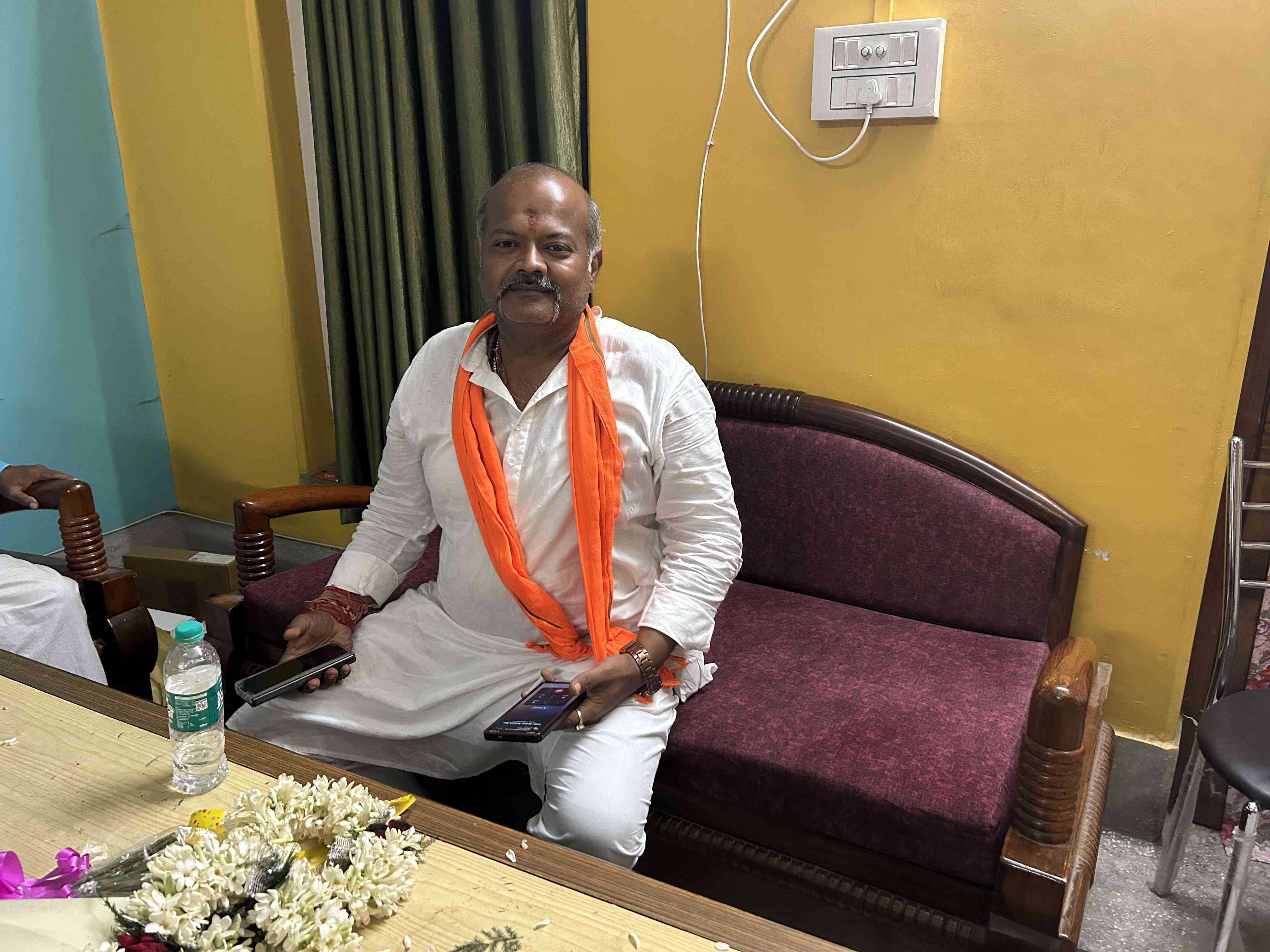
Meanwhile, the former MLA Tapash Chatterjee’s home wore a deserted look. The few admirers who still stuck around talked about how brave he was for staying at the counting centre after most of his agents had left. They had heard stories of other MLAs and even ministers who supposedly threw in the towel much earlier in the day.
“Being an Opposition MLA is also important,” Chatterjee explained. “Democracy has been murdered here. This is what happens when the referee plays for one side.”
